Nylon Pipe Fittings for Building Services: How Plumbing and HVAC Applications Are Served
Temperature, movement, and installation geometry interact differently inside a building than they do in a vehicle or production cell. Underfloor heating circuits may remain hidden beneath finished floors for years, while HVAC equipment can experience vibration, thermal expansion, and repeated maintenance connections.
Such conditions make nylon pipe fittings part of a broader system design rather than an isolated hardware choice. DEKUMA is a manufacturer of rubber and plastic processing machinery and extrusion systems, with equipment covering applications that include multilayer tubing for demanding fluid-handling environments.
Underfloor Heating and Push-Fit Connections
Underfloor heating places emphasis on controlled installation because tubing is typically distributed through long circuits before being concealed beneath the floor. A push-fit connection can simplify assembly by allowing prepared tubing to be inserted directly into the fitting, reducing the number of joining operations required around manifolds and branch points. The important considerations extend beyond insertion speed: tube outside diameter, dimensional consistency, insertion depth, sealing geometry, and resistance to temperature cycling all affect the finished joint.
Heating systems also experience a different thermal history from ordinary cold-water plumbing. A circuit repeatedly moves between operating and reduced temperatures, causing the pipe and fitting materials to expand and contract at different rates. ISO 15875:2025 addresses PE-X piping systems for hot and cold water and heating installations, including application classes, design temperatures, pressures, fittings, and joint fitness for purpose.
Routing beneath a floor introduces another practical constraint. Bends must maintain the required radius, while the tube should enter the connection without twisting or side-loading the fitting. A fitting that works well on a bench can behave differently if the connected tube is forced sideways during installation. For installers, access, repeatability, and the ability to inspect or replace exposed connections can be just as relevant as pressure capability.
HVAC Connections Under Thermal Movement
Air-handling equipment presents a contrasting environment. Flexible lines may connect sensors, actuators, valves, condensate-related components, or pneumatic controls, and the nearby equipment can transmit vibration into the connection. Temperature changes can also alter tubing flexibility and dimensional behavior.
The geometry of the fitting becomes particularly significant around compact HVAC assemblies. An angled connection can redirect tubing away from a crowded service area, while a short connection path can reduce unnecessary loops and exposed tubing. Such decisions should be made alongside bend-radius requirements and maintenance access.
Material construction provides another point of distinction. Building-service tubing may be selected for flexibility, thermal performance, oxygen-barrier requirements, or compatibility with a particular heating medium. Multilayer structures can combine different material characteristics within one wall, but the interface between layers still requires dimensional control during manufacture.
Why Building Standards Differ from Automotive and Industrial Uses
Building-service specifications are generally organized around the intended piping system, application class, pressure-temperature conditions, and joint performance. ISO 15875-3:2025, for example, specifically addresses fittings used with PE-X systems for hot and cold water installations and heating systems in buildings. ISO 22391 similarly covers PE-RT systems for hot and cold water and heating applications, including pipes, fittings, and joints.
Automotive applications introduce a different combination of constraints. Vehicle connections can encounter engine-compartment heat, vibration, limited installation space, chemical exposure, pressure pulses, and rapid temperature changes. Regulatory or OEM requirements may also apply to the specific fluid circuit. Industrial pneumatic systems, meanwhile, tend to emphasize operating pressure, actuation frequency, air quality, mechanical movement, and machine-specific maintenance practices.
The distinction becomes clearer when the word “compatibility” is examined closely. A building-services fitting may be designed around long service periods and standardized pipe dimensions, whereas an industrial connection may prioritize repeated assembly and disassembly. Automotive systems can impose still different requirements involving vehicle-specific validation and environmental durability. DEKUMA illustrates the manufacturing side of this distinction through equipment capable of producing multilayer tubing with controlled processing conditions rather than treating every tube structure as interchangeable.
Manufacturing Control and Connection Reliability
Dimensional consistency starts before installation. Wall thickness variation, ovality, layer concentricity, surface quality, and cooling behavior can influence how reliably tubing interacts with a fitting. A connector cannot compensate indefinitely for a tube whose dimensions vary beyond the assumptions of the joint design. This becomes particularly relevant with multilayer constructions because each layer contributes to the final geometry and mechanical response.
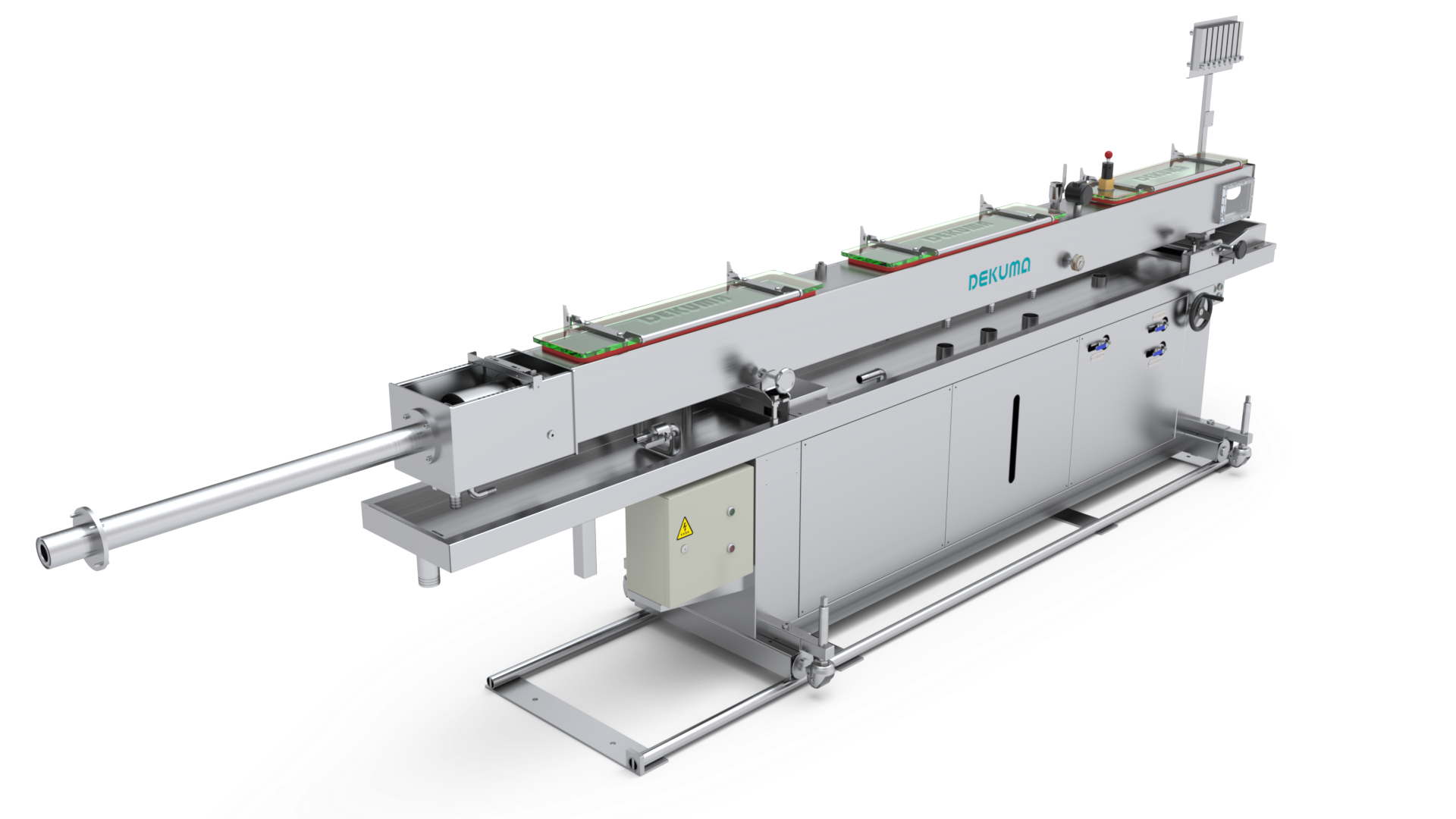
DEKUMA’s Multi-layer Nylon Composite Tube Extrusion Line uses three extruders to produce separate inner, middle, and outer layers. Its vacuum calibration tank has a 4-meter vacuum section, a 2.2 kW water pump, and a 1.6 kW vacuum pump. The two-layer tank structure is designed to improve insulation and reduce condensation on the surface, while support rollers allow quicker switching when downstream corrugating equipment is involved.
Such manufacturing considerations matter because fitting performance begins with the tube entering the joint. A stable outside diameter supports predictable insertion, while controlled wall geometry helps maintain the intended relationship between the tube and sealing components. In building services, that consistency can simplify installation across large projects containing hundreds or thousands of individual connections.
Conclusion
Building plumbing and HVAC networks may appear less mechanically demanding than automotive or factory equipment, yet their requirements are shaped by long service periods, concealed pipework, temperature changes, accessibility, and standardized joining systems. Nylon pipe fittings should consequently be considered in relation to the tube dimensions, application temperature, pressure, movement, installation method, and applicable building standard. Underfloor heating prioritizes joint compatibility and thermal cycling, while HVAC connections may place greater emphasis on vibration, compact routing, and service access.
The comparison with automotive and industrial systems also shows why a fitting specification cannot simply be transferred from one application to another. Each environment creates its own combination of mechanical, thermal, regulatory, and installation demands. DEKUMA operates in the machinery and tube-processing field, where controlled extrusion, calibration, and cooling contribute to the dimensional characteristics of multilayer products. Once those manufacturing variables are connected with the requirements of the final system, composite tube selection becomes a more informed engineering decision rather than a matter of matching nominal size alone.


